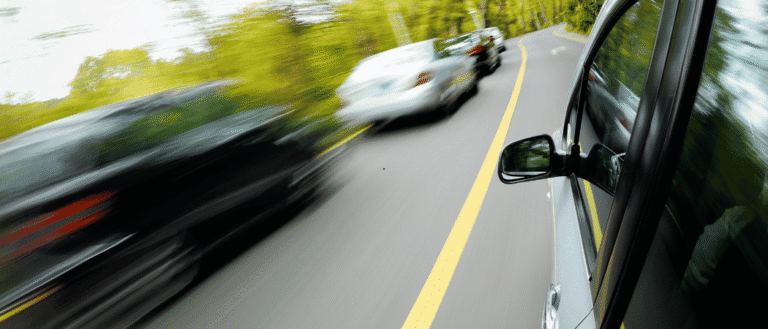

There’s one move on the road that can go from smart to expensive in about two seconds. From 1 January 2027, the UAE’s updated traffic rules spell out exactly when overtaking is fine and when it isn’t. I have all the important details you need to know, so keep reading to find out more.
When To Overtake On The Left & When To Overtake On The Right
Overtaking should be done from the left of the car ahead. Simple as that.
There’s one exception. If the car ahead has moved to the left to turn into another road, you can pass on the right, but only if all three of these are true: it has moved left to turn, it has signalled, and there’s enough space to pass safely. It’s a very specific exception, not a free pass to swerve around slower cars.
After you overtake, move back to the right without cutting in front of the car you just passed. Leave a safe gap so nobody has to slam on their brakes.
The Fast Lane Isn’t A Parking Spot
You can stay in the fast lane if you’re overtaking another car. But if you’re holding up the traffic behind you, it’s time to move over.
Six times you shouldn’t overtake at all
- When you can’t see clearly ahead. If visibility is poor, stay put.
- When oncoming traffic makes it unsafe. If there’s a car coming towards you, don’t risk it.
- At intersections and roundabouts.
- When the traffic ahead has stopped. Please don’t jump the queue.
- Near bends, slopes and slippery roads. The same goes for pedestrian crossings and anywhere there’s a solid line.
- Wherever signs say no overtaking.
These apply even if you think there’s enough space to get past.
What It’ll Cost You
Wrong overtaking comes with an AED 600 fine and 6 black points. Overtaking on the hard shoulder is steeper at AED 1,000 and 6 black points. The hard shoulder is there for emergencies, not for skipping past traffic. Black points add up too, and reaching 24 can mean your licence gets suspended.
A Quick Check Before You Move
Before you overtake, make sure you can see the road ahead clearly, no one is coming at you or into the lane you want, and you’ve signalled. Leave enough distance from the car you’re passing and keep your speed difference in mind.
The rules start on 1 January 2027, so you’ve got a little time to get comfortable with them. A bit of patience on the road is a lot cheaper than a fine.